
M371-Test
Information for physicians
The M371-Test is an IVDR-certified qPCR test for the diagnosis and follow-up of germ cell tumours using plasma or serum. It measures miR-371a-3p and provides answers where conventional serum tumour markers fail to deliver clear results: 92 % sensitivity and 96 % specificity in primary diagnosis, and 100 % and 96 % in recurrence detection. Uncertainty is transformed into a basis for decision-making.



M371-Test
When can the M371-Test be used?
- Small testicular lesions: Choosing between excision and orchiectomy
- Follow-up: Reliable detection of recurrence, less imaging
- Staging: Investigation of unexplained lymphadenopathies
- Unclear marker elevations: False-positive AFP, beta-hCG and LDH results
- Residual tumor following chemotherapy: particularly with seminoma



Preanalytics
Required materials for the M371-Test

Plasma: S-Monovette cfDNA Exact
When using plasma for the M371-Test test, blood must be collected using standard equipment into the S-Monovette cfDNA Exact from Sarstedt. The preparation of the Monovette reliably stabilises the miRNAs. The plasma does not need to be separated before the sample is dispatched.

Serum: S-Monovette Serum Gel CAT
For the use of serum in the M371-Test test, mir|detect recommends the S-Monovette Serum Gel CAT from Sarstedt. Blood is collected using standard equipment. The serum must be separated before dispatch. Other standard tubes for serum collection can be used.
Important tips for pre-analytical procedures
- Only the S-Monovette cfDNA Exact can be used for plasma. Individual tubes are available on request.
- It is recommended that 20G or 21G needles be used to reduce the risk of hemolysis.
- The blood collection tube must be filled completely up to the mark.
- Hemolysed samples may lead to false-negative results. Visibly hemolysed samples should be discarded.
- Whole blood for the M371-Test must not be frozen. Whole blood in the S-Monovette cfDNA Exact should not be refrigerated.
Procedure
How does the test procedure work?
M371-Test using Plasma
- Blood test: Approximately 9.2 ml of venous blood must be collected into an S-Monovette cfDNA Exact (Sarstedt; order no. 01.2040.001).
- Storage and dispatch: Whole blood in the S-Monovette cfDNA Exact can be shipped at ambient temperature. The miRNAs remain stable in the Monovette for up to 48 hours.
- Laboratory analysis: The laboratory collects the plasma, extracts the miRNA and carries out the M371-Test. The test takes approximately one working day to complete.
- Laboratory results: The test result includes the qualitative outcome (positive, negative or inconclusive). The result is usually made available to the physician within a week.
M371-Test using Serum
- Blood test: Approximately 9.0 ml of venous blood must be collected into a serum gel tube containing a clotting activator. mir|detect recommends using the S-Monovette Serum Gel CAT (Sarstedt; Order No. 02.1388.001).
- Serum collection: The sample must be stored upright at room temperature for 30 to 40 minutes to allow it to clot. The sample must then be centrifuged at 2,500 x g for 10 minutes, after which the serum must be collected.
- Storage and dispatch: Serum can be frozen at -20°C for up to 16 days or at -80°C for longer-term storage. It must be dispatched in a frozen state using dry ice or suitable cooling packs. The miRNAs remain stable during transport for up to 90 hours at temperatures below 0°C.
- Laboratory analysis: The laboratory extracts the miRNA from the serum and carries out the M371-Test. The test takes approximately one working day to complete.
- Laboratory results: The test result includes the qualitative outcome (positive, negative or inconclusive). The result is usually made available to the physician within a week.
Evidence
Where can I find the clinical evidence?
The clinical performance of the M371-Test has been demonstrated by the two landmark, prospective clinical trials conducted by Dieckmann et al. (2019) and Belge et al. (2024) as well as numerous other independent studies worldwide.
Primary diagnostics
Dieckmann et al. (2019) conducted a prospective study at 37 centres in Germany, Austria, Switzerland, Hungary and Italy, the researchers analysed serum samples from 522 patients with germ cell tumours and 258 controls. In primary diagnosis, the M371-Test achieved a sensitivity of 91.8 % and a specificity of 94.0 %, with a positive predictive value of 97.2 %. AFP, beta-hCG and LDH remained below 50 % sensitivity in seminoma cases. However, the study clearly highlights one limitation: pure teratomas do not express miR-371a-3p.
In 118 patients with systemic disease, serial measurements were also taken during chemotherapy. The marker fell significantly after the first cycle alone. In the 70 patients with stage IIa/b disease, further cycles did not result in any further significant decline. In stage III (n = 46), a second significant fall occurred after the second cycle, after which the level remained stable. The marker levels also correlated with stage, tumour size and response to treatment. The marker was elevated in cases of relapse and returned to normal during remission.
Follow-up monitoring
Belge et al. (2024) conducted a prospective study involving 258 patients at clinical stage I across 23 urology centres in Germany, Austria and Italy, over a median period of 18 months and comprising 1,179 individual measurements. 39 patients suffered a recurrence. The M371-Test detected all 39, with a specificity of 96.3 %. β-hCG achieved a sensitivity of 35.5 %, AFP 25.0 %, and both markers combined 45.2 %.
The negative predictive value was 100 %, and the positive predictive value was 83 %. Eight of the 219 recurrence-free patients had elevated levels, but these were significantly lower than those in the confirmed recurrences (median RQ 37.6 versus 153.7). In 11 of the 39 recurrences (28 %), miR-371a-3p levels rose three to 15 months before detection via imaging or conventional markers. The median time to diagnosis of recurrence was six months for both approaches. Elevated levels immediately following orchiectomy did not predict subsequent recurrence.
An independent Swiss cohort study confirms these findings. Fankhauser et al. (2024) followed 34 Stage I patients under active surveillance, recording 108 measurements, of which 18 were seminomas and 16 were non-seminomas. All 10 recurrences that occurred were detected. The authors confirmed that an RQ threshold of 15 is optimal for detecting recurrence. In both studies, false-positive results usually normalised by the next measurement. Both research groups therefore recommend confirming an elevated value with a second measurement before taking any further action.
Clinical performance of M371-Test
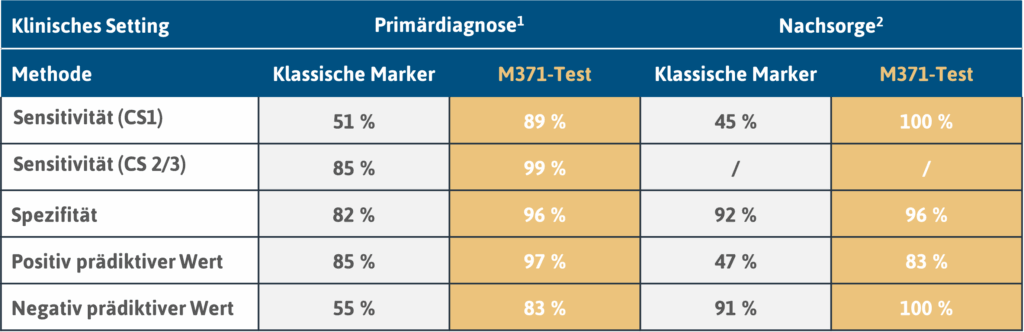
1 n = 522 patients; 258 controls (Dieckmann et al., 2019; https://doi.org/10.1200/jco.18.01480)
2 n = 258 patients (Belgium et al., 2024; https://doi.org/10.1158/1078-0432.ccr-23-0730)
Classic markers: AFP (α-fetoprotein), bHCG (β-subunit of human chorionic gonadotropin) and LDH (lactate dehydrogenase)
Contact us
mir|detect: Biotechnology from Bremerhaven
Our mission:
Clarity & safety for testicular cancer.